What 1,470% Daily Value Means on a Trimoryn Label
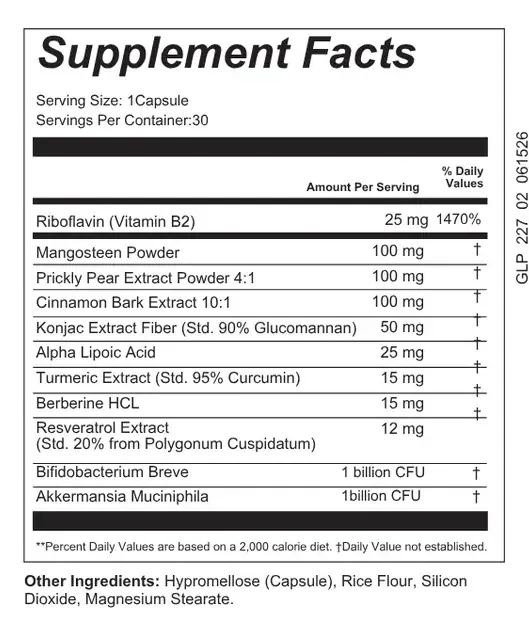
A % Daily Value compares one serving to a fixed reference amount. Trimoryn's panel lists riboflavin at 25 mg against an adult need near 1.3 mg, which rounds to 1,470%. Riboflavin is water soluble with no upper limit set, so the harmless result is bright yellow urine, not a safety concern. The other ten ingredients carry no Daily Value at all, so no percentage exists for them to compare.
A percentage that stops people mid-scroll
Flip a bottle of Trimoryn to the back and one number on the Supplement Facts panel is printed bigger than the rest, at least in how much attention it grabs: riboflavin, 25 mg, 1,470%. Every other line on the same panel carries a dagger and the words “Daily Value not established.” Only one ingredient out of eleven gets a percentage at all, and it is a four-digit one.
That gap is worth understanding on its own terms, not just for this bottle. Once you know what a % Daily Value is actually measuring, a number like 1,470% stops being either scary or impressive. It becomes just arithmetic, and arithmetic you can check yourself on any label in your cabinet.
What a % Daily Value actually is
The % Daily Value column exists because a milligram figure alone tells you nothing about whether that amount is a lot or a little for a human body. Fifty milligrams of vitamin C is a small fraction of a day’s need. Fifty milligrams of vitamin B12 would be an almost unimaginable multiple of it. The raw number cannot tell the two apart; the percentage can.
| Term | What it means |
|---|---|
| Daily Value (DV) | A fixed reference amount, set by regulation, meant to cover most healthy adults' daily need for that nutrient |
| % Daily Value | The amount in one serving, divided by the Daily Value, shown as a percentage |
| † (dagger) | Printed when no Daily Value has ever been set for that ingredient, so no percentage can be calculated |
A Daily Value is not the same thing as a research dose, and it is not tailored to your age, sex or health. It is a single reference number, built for label comparison, nothing more. Riboflavin has one. Ten of Trimoryn's eleven ingredients do not, which is why the panel looks so lopsided.
Where the 1,470% figure comes from
The current adult Daily Value for riboflavin (vitamin B2) is 1.3 mg. Trimoryn's panel lists 25 mg per capsule. Divide one by the other and multiply by 100, and the panel is required to round to 1,470%. There is no hidden formula and nothing proprietary about it (National Institutes of Health, 2024).
For comparison, the adult RDA most people actually need day to day sits between 1.1 and 1.3 mg, depending on sex. Twenty-five milligrams is roughly nineteen times that amount. It looks dramatic on the page mostly because riboflavin needs are so small to begin with, not because 25 mg is an unusual dose to take.
| Value | Amount |
|---|---|
| Adult RDA for riboflavin | 1.1-1.3 mg/day |
| Trimoryn capsule | 25 mg |
| Multiple of the RDA | about 19x |
| % Daily Value printed | 1,470% |
Why there is no upper limit on a number this size
A high percentage on a fat-soluble vitamin, like A or D, is worth pausing over, because those vitamins store in body fat and can build up. Riboflavin does not work that way. It dissolves in water, and the body holds onto only what it needs at that moment; anything beyond that clears out in urine within hours.
The Food and Nutrition Board sets a Tolerable Upper Intake Level (UL) for nutrients where high doses have been shown to cause harm. For riboflavin, no UL has ever been set, because studies giving healthy adults up to 400 mg a day, for three months or more, have not turned up adverse effects (National Institutes of Health, 2024). Twenty-five milligrams sits well inside territory that has already been studied at sixteen times that amount.
That does not make riboflavin at 25 mg useful for weight management on its own. It simply means the number on the panel is a math result, not a safety flag. The two questions, "is this a lot compared to the RDA" and "is this a lot in an absolute, dangerous sense," have very different answers here.
The bright yellow urine, explained
The one visible sign, and what it is not
Most people who start a riboflavin-containing supplement notice their urine turn a distinct, almost fluorescent yellow, often within the first day. It can be startling the first time, especially without warning.
That color change is riboflavin itself, not a byproduct of anything going wrong. Cleveland Clinic describes it plainly: riboflavin has no known serious side effects at high intakes because the excess simply leaves the body through urine, and the bright yellow tint is that excretion, visible (Cleveland et al., 2024).
Worth knowing before a doctor’s visit, too: a bright yellow sample can occasionally interfere with how some urine-based readings look. Mentioning a B2 supplement before a test costs nothing and avoids a false alarm.
When a big percentage is meaningful, and when it is just cheap filler math
A four-digit Daily Value is not automatically meaningful, and it is not automatically meaningless either. It depends entirely on what nutrient is behind the number and what your body does with an excess of it.
| Question to ask | Why it matters |
|---|---|
| Is the nutrient water-soluble or fat-soluble? | Water-soluble excess clears in urine; fat-soluble excess can accumulate in the body over time |
| Has a Tolerable Upper Intake Level been set? | If yes, compare the dose against it directly, not just against the RDA |
| Is the ingredient actually doing the work the product is sold for? | A high %DV vitamin can be along for the ride rather than the reason the product exists |
| Is the %DV replacing a real research-dose comparison? | A striking percentage on one line can distract from ten other lines carrying no percentage at all |
On this panel, the honest read is that 1,470% is a genuine, harmless result of riboflavin being cheap and safe at higher amounts, not evidence that the capsule is unusually potent for weight management. The percentage describes one vitamin. It says nothing about the other ten ingredients riboflavin shares the capsule with.
The dagger lines: ten ingredients with no Daily Value at all
| Ingredient | Per capsule | % DV |
|---|---|---|
| Riboflavin (Vitamin B2) | 25 mg | 1470% |
| Mangosteen Powder | 100 mg | Daily Value not established |
| Prickly Pear Extract Powder 4:1 | 100 mg | Daily Value not established |
| Cinnamon Bark Extract 10:1 | 100 mg | Daily Value not established |
| Konjac Extract Fiber (Std. 90% Glucomannan) | 50 mg | Daily Value not established |
| Alpha Lipoic Acid | 25 mg | Daily Value not established |
| Turmeric Extract (Std. 95% Curcumin) | 15 mg | Daily Value not established |
| Berberine HCL | 15 mg | Daily Value not established |
| Resveratrol Extract (Std. 20% from Polygonum Cuspidatum) | 12 mg | Daily Value not established |
| Bifidobacterium Breve | 1 billion CFU | Daily Value not established |
| Akkermansia Muciniphila | 1 billion CFU | Daily Value not established |
The dagger is not a red flag on its own. Mangosteen, prickly pear, cinnamon, konjac fiber, alpha lipoic acid, turmeric, berberine, resveratrol and the two live cultures are all real, named, weighed or counted ingredients. They simply belong to a category, plant extracts and probiotic strains among them, that the federal Daily Value system has never assigned a reference amount to.
That leaves riboflavin as the only line on the panel where a percentage comparison is even possible. For what those other 442 mg of weighed ingredients are and how their amounts compare with research doses instead, see the full ingredient breakdown.
Reading a % Daily Value on any panel you own
Find the Daily Value column
Not every panel has one for every line. A dagger or footnote symbol means no reference amount exists for that ingredient.
Check whether the nutrient is water- or fat-soluble
B vitamins and vitamin C are water-soluble and generally forgiving. A, D, E and K store in the body and deserve more caution at high percentages.
Compare the milligram amount to the RDA, not just the percentage
A striking percentage and a genuinely large absolute dose are two different things worth checking separately.
Look for whether an upper limit has been set
NIH's Office of Dietary Supplements publishes Tolerable Upper Intake Levels for the nutrients that have one. No listing usually means no established harm at studied doses, not that any amount is automatically fine.
Treat a missing Daily Value as a gap, not a red flag
Plant extracts, fiber and probiotic strains often carry no DV at all. That is a limit of the labeling system, not a statement about the ingredient's safety or usefulness.
None of this makes riboflavin, or anything else on this panel, a weight-loss treatment. Reading a % Daily Value correctly is about understanding what a label is telling you, not about predicting an outcome on the scale. Keep taking any prescribed medicine on schedule regardless of what a supplement panel says.
For how the other ten ingredients’ amounts stack up against the studies behind them, see what 4:1 and 10:1 extract ratios actually mean. For the fiber line specifically, see how to take a fiber supplement safely.
Questions readers ask
What does % Daily Value actually mean?
It is the amount of a nutrient in one serving divided by a fixed federal reference amount, the Daily Value, shown as a percentage. It measures how a serving compares to that reference, not how strong or effective the ingredient is.
Why is riboflavin the only ingredient with a percentage on this label?
A Daily Value exists only for nutrients that regulators have assigned a reference amount to. Riboflavin has one. The other ten ingredients on this panel, including both live cultures, do not, so each is marked with a dagger instead.
Is 1,470% dangerous?
No safety signal is attached to it. Riboflavin is water soluble, no Tolerable Upper Intake Level has been set for it, and studies giving adults up to 400 mg a day for months have not shown harm. Twenty-five milligrams is well inside that studied range.
Why does riboflavin turn urine bright yellow?
The body uses what it needs and clears the rest through urine. Riboflavin has a strong natural yellow pigment, so the excess being excreted is visibly bright yellow, usually within hours of taking it.
Does a dagger symbol mean an ingredient is unsafe?
No. It means no Daily Value has been established for that ingredient, which is common for plant extracts, fiber and probiotic strains. It is a gap in the labeling system, not a warning about the ingredient itself.
Does a high %DV mean an ingredient works better for weight management?
No. The percentage only describes how one nutrient's amount compares to a reference intake. It says nothing about whether that ingredient, or the product as a whole, produces any particular result.
How much riboflavin do adults actually need each day?
The adult RDA is 1.1 to 1.3 mg a day depending on sex. Trimoryn's 25 mg is roughly nineteen times that amount, which is where the 1,470% figure comes from.
Where can I see this ingredient compared with the rest of the capsule?
Keep reading
Akkermansia, the newest gut strain
What Akkermansia muciniphila is, the small 2019 pilot trial behind it, EFSA's clearance, and the gap between that trial ...
Read →Before a meal or with food
Why Trimoryn's label says 15-30 minutes before a meal, fat- versus water-soluble absorption, and what to do if you take ...
Read →How much does Trimoryn cost?
Pack sizes, days of supply and how to pick the right one.
Read →Order Trimoryn from the authorized retailer
60 servings per bottle, 1 to 2 droppers a day. Kits of 2, 3 or 6 bottles run from $49 a bottle on the sales page, with a 60-day money-back guarantee. Questions first? Call +1 (323) 391-7425.