How Does Trimoryn Work? Each Ingredient's Role
Trimoryn combines eleven ingredients, and each one is studied for its own mechanism.
Riboflavin plays a role in energy metabolism, berberine acts on an enzyme called AMPK, and cinnamon bark extract comes closest to a studied amount.
For the full label, see every ingredient and amount.
Eleven mechanisms, one capsule
"How it works" is really eleven separate stories, not one. Each ingredient on this panel has its own line of research behind it, aimed at its own mechanism. The table below states that mechanism plainly, then says whether the amount on this label has actually been tested at that mechanism's effective dose.
| Ingredient | Studied for | Does this amount support it? |
|---|---|---|
| Riboflavin (Vitamin B2) | Acting as a cofactor that helps cells convert food into usable energy | Yes, easily, but that role is not a weight or metabolism mechanism |
| Mangosteen Powder | Antioxidant and glycemic effects from its xanthone compounds | Unclear; no standardized human dose exists to compare against |
| Prickly Pear Extract 4:1 | Lowering blood glucose and insulin, mainly from the cactus pad | Unclear; the amount here is far below whole-cladode study amounts |
| Cinnamon Bark Extract 10:1 | Lowering fasting blood glucose | Close. The gram-equivalent reaches the low end of the studied range |
| Konjac Extract Fiber | Creating fullness by swelling into a gel in the stomach | No, at roughly 1/65th of the dose behind the EU fullness claim |
| Alpha Lipoic Acid | Antioxidant activity with a modest effect on body weight at high doses | No, at roughly 1/25th of the doses that produced that modest effect |
| Turmeric Extract (Curcumin) | Blocking an inflammation signal called NF-kB | No. Curcumin absorbs poorly without piperine, which this label lacks |
| Berberine HCL | Activating AMPK, a cellular switch tied to glucose and lipid handling | No, at roughly 1/67th of the doses shown to engage that switch |
| Resveratrol Extract | Activating sirtuin proteins linked to metabolism and aging | No, and trials at far higher doses already found no metabolic benefit |
| Bifidobacterium breve | Reducing body fat mass in a strain-specific trial | No, at roughly 1/50th of that trial's dose, and the strain is not confirmed |
| Akkermansia muciniphila | Improving insulin sensitivity, shown with the pasteurized form | No, at roughly 1/10th of the pilot dose, and live-or-pasteurized is not stated |
The seller's step graphic, read for what it is
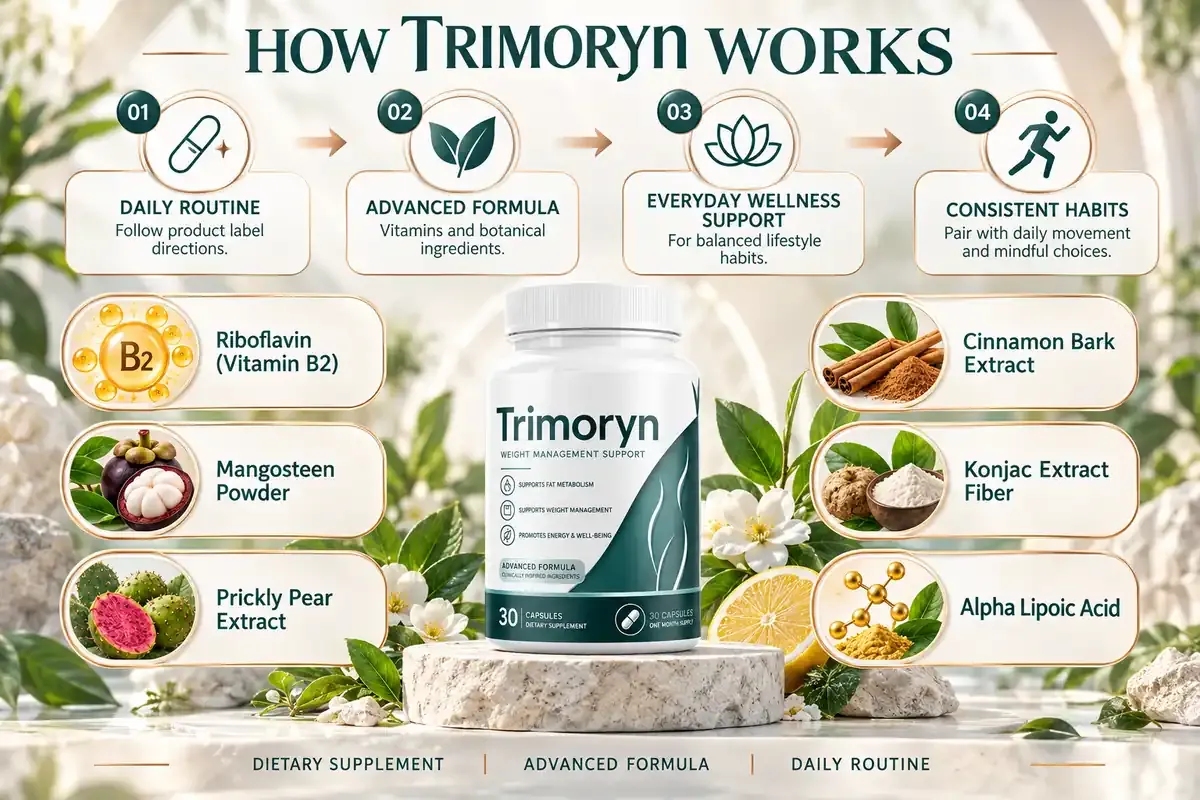
What the seller's "How It Works" graphic actually shows
This is seller artwork, not a diagram of anything happening inside the body. Its four steps read Daily Routine, Advanced Formula, Everyday Wellness Support and Consistent Habits, which describe a habit, not a mechanism.
Underneath, it pictures six ingredients: riboflavin, mangosteen, prickly pear, cinnamon, konjac and alpha lipoic acid. No arrow connects any of them to a specific step, and no pathway, receptor or process is named anywhere in the graphic.
The five ingredients this artwork leaves out, turmeric, berberine, resveratrol and the two live cultures, are exactly the five with the more specific mechanism research, cited below. A reader who only saw this graphic would miss most of the actual science.
Five mechanisms, measured against this label's dose
The filled part of each rung is the amount in one capsule. The whole rung is the amount the cited research used. The number on the right is how many times bigger the research dose is.
Riboflavin (Vitamin B2)
at dose25 mgon this label1.1 to 1.3 mg a day, the adult RDAused in researchRiboflavin's studied job is helping cells turn food into energy, not burning fat. National Institutes of Health, 2024 sets that reference intake, and 25 mg clears it many times over, which is the whole reason a percentage appears on the panel. That surplus has never been tested as a weight-loss mechanism, because it is not one.
Bifidobacterium breve
50×1 billion CFUon this labelabout 50 billion CFU a dayused in researchMinami et al., 2015 found lower body fat mass in adults after twelve weeks at fifty times this label's amount. The strain can still be alive at 1 billion CFU; it simply has not been tested at this amount for this effect.
Berberine HCL
67×15 mgon this label1,000 to 1,500 mg a dayused in researchBerberine's studied mechanism is switching on AMPK, a cellular energy sensor tied to glucose and lipid handling. Dong et al., 2012 pooled trials at roughly sixty-seven times this label's amount. Whether 15 mg engages that switch at all has not been tested.
Turmeric Extract (Curcumin)
36×about 14 mg curcuminon this label500 to 1,000 mg curcumin a dayused in researchCurcumin's studied mechanism blocks an inflammation signal called NF-kB, but Hewlings et al., 2017 notes it barely enters the bloodstream without piperine or another delivery aid. This capsule supplies neither the piperine nor close to the dose those trials used.
Resveratrol Extract
62×about 2.4 mg resveratrolon this label150 to 500 mg a dayused in researchResveratrol is studied for activating sirtuin proteins linked to metabolism. Zahoor et al., 2024 pooled trials at roughly sixty-three times this label's amount and still found no measurable metabolic benefit, so the mechanism has already been tested at a real dose and come up empty.
A smaller amount is not the same as no amount, and none of this says the capsule does nothing. It says that if you are expecting the result a trial reported, the trial was not testing this much.
Mangosteen and prickly pear are left off this chart on purpose: no published human trial reports a single standardized dose for either one, so there is nothing solid to measure this label against. That gap is a limit in the research, not a mark in either ingredient's favor.
The mechanisms grouped by what they actually target
Blood sugar mechanisms
Berberine, alpha lipoic acid and cinnamon are each studied for lowering blood sugar through different pathways. Stacked together, and with any glucose-lowering medicine, that is a hypoglycemia question for a clinician.
Antioxidant and anti-inflammatory mechanisms
Turmeric, resveratrol and mangosteen are studied for reducing oxidative stress or inflammation markers. All three appear here at a fraction of their researched doses.
Gut mechanisms
Bifidobacterium breve and Akkermansia muciniphila are studied for changing the gut environment itself, not for a direct calorie or appetite effect.
Fullness and energy mechanisms
Konjac fiber works by physically swelling in the stomach. Riboflavin works as a vitamin cofactor. Neither mechanism is a fat-burning one.
How to read any 'mechanism' claim on a supplement label
Name the mechanism, not the marketing word
"Supports fat metabolism" is not a mechanism. Ask what pathway a study actually measured, such as AMPK activation or fasting glucose, before deciding an ingredient is doing anything.
Compare the label amount with the studied amount
The dose ladder above does this for five lines. If a study used ten or sixty times more than this capsule provides, the mechanism it reported is not a claim about this capsule.
Separate the mechanism from the outcome
A pathway being activated in a lab is not the same as pounds lost in a person. Several of the trials cited on this page found the mechanism moved without the scale moving.
Ask a clinician before stacking mechanisms
Three ingredients here lower blood sugar through different routes. Combined with diabetes medicine, that overlap is a question for whoever prescribes it, not for a label.
What this page is not saying
Every pathway named on this page comes from real published research on that ingredient, not from this product. None of it has been tested on Trimoryn itself as a finished capsule, and Trimoryn is not a weight-loss drug or a diabetes treatment. Keep taking any prescribed medicine as directed, and ask a clinician before combining this with glucose- or blood pressure-lowering medicine.
The amounts behind each mechanism are set out on the ingredients page, and the interactions worth asking about first are on the side effects page.
How It Works: common questions
Does Trimoryn have a proven mechanism of action?
Each ingredient has its own studied mechanism in outside research. The finished capsule itself has not been tested as a whole.
Which ingredient's dose comes closest to its research mechanism?
Cinnamon. Its 10:1 extract reaches the low end of the gram range studied for lowering fasting glucose.
What does berberine actually do, mechanically?
Trials link it to activating AMPK, a cellular switch involved in glucose and lipid handling, at doses far above this label's 15 mg.
Why doesn't turmeric work as well without piperine?
Curcumin absorbs poorly on its own. Most trials that found an effect paired it with piperine or another delivery system, which this label does not include.
Is the seller's 'How It Works' graphic a scientific diagram?
No. It shows four generic lifestyle steps and six ingredient pictures, with no pathway or process named.
Do mangosteen and prickly pear have a known effective dose?
No single standardized human dose has been published for either one, so this label's amount cannot be reasonably measured against one.
Can these mechanisms replace diabetes or blood pressure medicine?
No. Nothing on this label is a substitute for prescribed medicine, and several of its ingredients can interact with it.
Keep reading
Every ingredient, plainly identified
What each of the eleven lines actually is, and its exact printed amount.
Read →Every claim, and where it comes from
Label claims, artwork claims and the sales-page title, sorted from what evidence exists.
Read →Interactions and cautions to check first
Berberine, blood sugar, glucomannan and water, and the rest of the safety picture.
Read →Order Trimoryn from the authorized retailer
60 servings per bottle, 1 to 2 droppers a day. Kits of 2, 3 or 6 bottles run from $49 a bottle on the sales page, with a 60-day money-back guarantee. Questions first? Call +1 (323) 391-7425.