Trimoryn Ingredients: What Is in Each Capsule
Each Trimoryn capsule holds eleven ingredients, and every one is printed with its own amount.
That is 442 mg of weighed material, led by mangosteen, prickly pear and cinnamon bark at 100 mg each, plus two live cultures at 1 billion CFU each.
For the label line by line, read the Supplement Facts page.
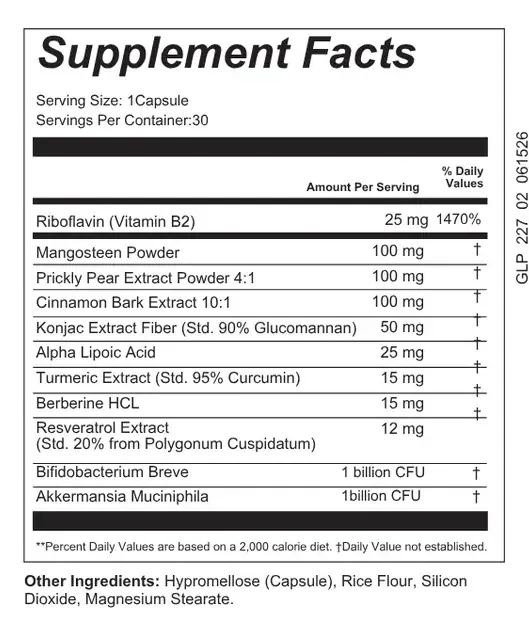
The panel, exactly as printed
| Ingredient, as printed | Amount per capsule | % Daily Value |
|---|---|---|
| Riboflavin (Vitamin B2) | 25 mg | 1470% |
| Mangosteen Powder | 100 mg | † |
| Prickly Pear Extract Powder 4:1 | 100 mg | † |
| Cinnamon Bark Extract 10:1 | 100 mg | † |
| Konjac Extract Fiber (Std. 90% Glucomannan) | 50 mg | † |
| Alpha Lipoic Acid | 25 mg | † |
| Turmeric Extract (Std. 95% Curcumin) | 15 mg | † |
| Berberine HCL | 15 mg | † |
| Resveratrol Extract (Std. 20% from Polygonum Cuspidatum) | 12 mg | † |
| Bifidobacterium Breve | 1 billion CFU | † |
| Akkermansia Muciniphila | 1 billion CFU | † |
The dagger means no established Daily Value, true of ten of eleven lines. Full walkthrough: the Supplement Facts page.
What each ingredient actually is
| Ingredient | What it actually is | What this amount is |
|---|---|---|
| Riboflavin (Vitamin B2) | B vitamin, energy metabolism | 25 mg, about 19x the adult RDA |
| Mangosteen Powder | Dried Garcinia mangostana fruit powder | 100 mg, tied for the largest line |
| Prickly Pear Extract Powder 4:1 | Opuntia ficus-indica cactus extract | 100 mg, about 400 mg raw cactus |
| Cinnamon Bark Extract 10:1 | Cinnamomum bark, species not stated | 100 mg, about 1 g raw bark |
| Konjac Extract Fiber | Konjac root fiber, 90% glucomannan | 50 mg, about 45 mg glucomannan |
| Alpha Lipoic Acid | A naturally occurring fatty acid | 25 mg, taken on its own |
| Turmeric Extract (Std. 95% Curcumin) | Curcuma longa root extract | 15 mg, about 14 mg curcumin, no piperine |
| Berberine HCL | Alkaloid from barberry-family plants | 15 mg, second-smallest line on the panel |
| Resveratrol Extract (Std. 20%) | Japanese knotweed root extract | 12 mg, about 2.4 mg resveratrol |
| Bifidobacterium breve | Live gut bacterial strain | 1 billion CFU, no strain code given |
| Akkermansia muciniphila | Gut bacterium, feeds on mucus lining | 1 billion CFU, live or pasteurized not stated |
A ratio like 4:1 says how concentrated the plant is, not how strong the effect is; Gouws et al., 2019 and Deyno et al., 2019 both used far more raw material.
Six get a picture. Eleven get a number.
| Ingredient | Per capsule | % DV | In the art? |
|---|---|---|---|
| Riboflavin (Vitamin B2) | 25 mg | 1470% | On the panel |
| Mangosteen Powder | 100 mg | † | On the panel |
| Prickly Pear Extract Powder 4:1 | 100 mg | † | On the panel |
| Cinnamon Bark Extract 10:1 | 100 mg | † | On the panel |
| Konjac Extract Fiber (Std. 90% Glucomannan) | 50 mg | † | On the panel |
| Alpha Lipoic Acid | 25 mg | † | On the panel |
| Turmeric Extract (Std. 95% Curcumin) | 15 mg | † | Label only |
| Berberine HCL | 15 mg | † | Label only |
| Resveratrol Extract (Std. 20% from Polygonum Cuspidatum) | 12 mg | † | Label only |
| Bifidobacterium Breve | 1 billion CFU | † | Label only |
| Akkermansia Muciniphila | 1 billion CFU | † | Label only |
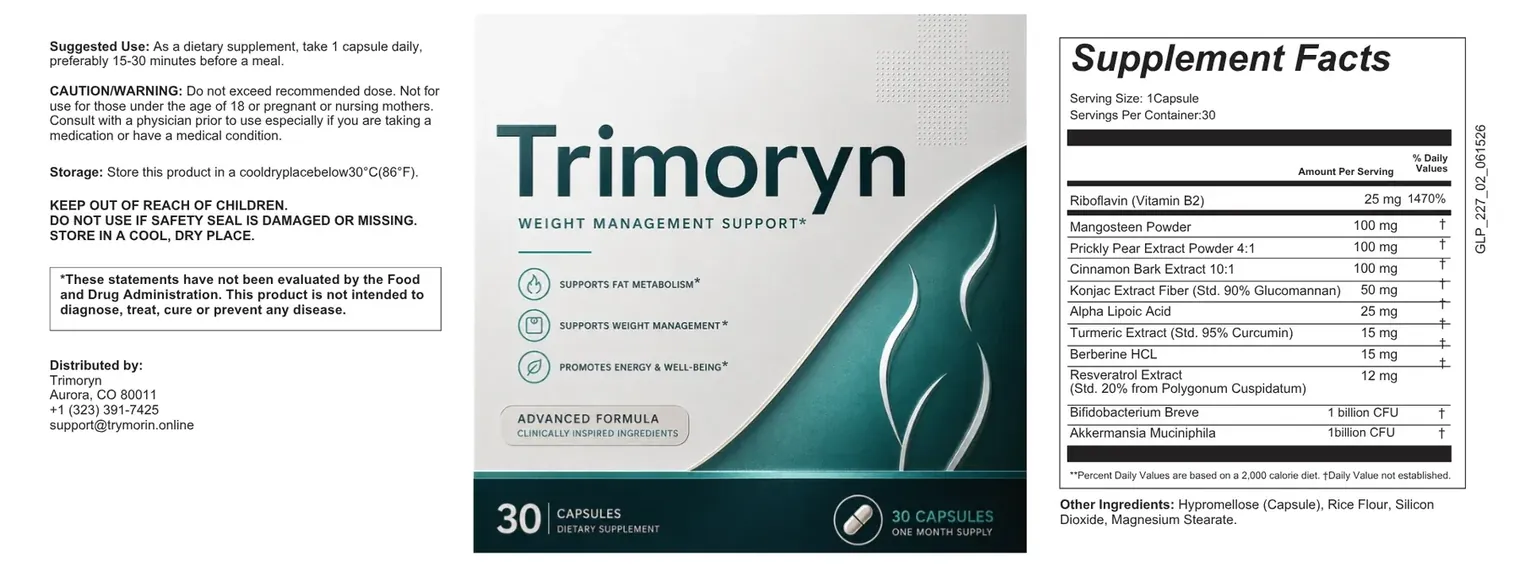
Nothing here is hidden: the bottle prints all eleven amounts and uses no proprietary blend. The five marked label only are simply the ones the ingredient graphics leave out.
Look up any ingredient
Riboflavin (Vitamin B2)
riboflavin · B vitamin
The one line with a Daily Value, and it is about nineteen times the adult RDA. This label's 25 mg is roughly 19-23x the adult RDA of 1.1-1.3 mg/day, delivered as a water-soluble vitamin that is not stored and is excreted once needs are met (turning urine bright yellow).
- In one serving
- 25 mg (1,470% of the Daily Value)
- Dose used in research
- Adult RDA is 1.1-1.3 mg/day
- Safety note
- Riboflavin is water soluble with no established Tolerable Upper Intake Level, and NIH ODS and Cleveland Clinic both report no known serious adverse effects from high intakes.
Mangosteen Powder
Garcinia mangostana · fruit powder
A tropical fruit powder tied for the largest line on the panel. Only 2 small human studies of mangosteen peel extract for glycemic control could be identified, with short follow-up and inconsistent extract preparations, and there is regulatory history (a 2006 FDA warning letter) of mangosteen juice products being marketed with unsubstantiated disease claims.
- In one serving
- 100 mg
- Dose used in research
- not established
- Safety note
- No dedicated, well-powered clinical safety trial of mangosteen (Garcinia mangostana) supplementation could be found and confirmed.
- Sources
- Purwoko et al., 2026
Prickly Pear Extract Powder 4:1
Opuntia ficus-indica · cactus pad and fruit
Cactus extract sold for fat binding and blood sugar. 4:1 means four parts plant reduced to one. A meta-analysis found no significant effect on body weight, though small reductions in BMI, body fat, blood pressure, and cholesterol were seen; a separate systematic review found the cladode (not the fruit) most consistently associated with lower blood glucose and insulin.
- In one serving
- 100 mg of a 4:1 extract
- Dose used in research
- human trials of Opuntia ficus-indica cladode/fruit extracts have used varying preparations
- Safety note
- Available randomized trials of Opuntia ficus-indica have not reported serious safety signals, and a 2015 meta-analysis found small, favorable changes in some cardiovascular risk markers alongside no significant weight change.
- Sources
- Gouws et al., 2019 · Onakpoya et al., 2015
Cinnamon Bark Extract 10:1
Cinnamomum · bark
The label does not say which cinnamon species, and that matters for coumarin. A 2019 meta-analysis of 16 RCTs found cinnamon modestly lowered fasting glucose but not HbA1c.
- In one serving
- 100 mg of a 10:1 extract
- Dose used in research
- meta-analyses of cinnamon for glycemic control have pooled trials using roughly 120 mg to 6,000 mg/day
- Safety note
- Because this label does not state which cinnamon species is used, the coumarin content cannot be determined: Cassia cinnamon (Cinnamomum aromaticum/cassia) is naturally high in coumarin, while Ceylon cinnamon (Cinnamomum verum) contains only trace amounts.
- Sources
- Deyno et al., 2019
Konjac Extract Fiber (Std. 90% Glucomannan)
Amorphophallus konjac · root fiber
A soluble fiber studied for fullness, at a fraction of the amount used in trials. This label supplies 50 mg of konjac extract standardized to 90% glucomannan (about 45 mg of actual glucomannan) -- roughly 1/65th of the 3 g/day dose EFSA's opinion is based on, and far below the 1-3 g+/day used in clinical trials.
- In one serving
- 50 mg standardized to 90% glucomannan (about 45 mg glucomannan)
- Dose used in research
- the EU-authorized health claim for glucomannan and weight loss specifies 3 g/day, divided into 3 doses of 1 g taken with 1-2 glasses of water before meals
- Safety note
- Glucomannan carries a well-documented, dose-related choking and gastrointestinal/esophageal obstruction hazard when swallowed without adequate fluid, particularly in tablet form.
- Sources
- Onakpoya et al., 2014 · EFSA et al., 2010
Alpha Lipoic Acid
alpha lipoic acid · fatty acid
An antioxidant studied for blood sugar and nerve comfort, usually at far higher doses. A 2018 meta-analysis of 12 RCTs (doses up to 1,200 mg/day) found only a modest, clinically minor reduction in body weight and BMI.
- In one serving
- 25 mg
- Dose used in research
- clinical trials of alpha-lipoic acid for weight/metabolic outcomes have used roughly 300-1,800 mg/day, most commonly up to 1,200 mg/day, for 8-24 weeks
- Safety note
- A large pooled safety analysis of alpha-lipoic acid across 71 randomized trials found no significantly increased risk of adverse events, but rare published case reports describe insulin autoimmune syndrome (Hirata disease) -- a cause of dangerous, sometimes severe hypoglycemia -- temporally associated with ALA supplementation, generally at higher doses than this product provides.
- Sources
- Namazi et al., 2018
Turmeric Extract (Std. 95% Curcumin)
Curcuma longa · root
Printed on the label but left off every marketing panel. This label's 15 mg of turmeric extract standardized to 95% curcumin supplies only about 14 mg of actual curcumin -- roughly 1/35th to 1/70th of the doses used in most human research, and it is not stated to include piperine or another bioavailability-enhancing delivery system, so absorption is expected to be poor.
- In one serving
- 15 mg standardized to 95% curcumin (about 14 mg curcumin)
- Dose used in research
- human studies of curcumin have used roughly 80-2,000 mg/day, most commonly 500-1,000 mg/day, frequently combined with piperine or another delivery system to improve absorption
- Safety note
- LiverTox identifies turmeric/curcumin as the most common cause of clinically apparent herb-induced liver injury reported in the United States in recent years, though the estimated incidence is very rare (roughly 1 in 10,000 to 1 in 100,000 users).
- Sources
- Hewlings et al., 2017
Berberine HCL
berberine hydrochloride · plant alkaloid
The ingredient with the most drug interactions in this formula, at the second smallest weight. This label's 15 mg is roughly 1/67th to 1/100th of the 1,000-1,500 mg/day used in the reviewed trials, far too low to be expected to reproduce the glycemic or lipid effects reported there.
- In one serving
- 15 mg
- Dose used in research
- clinical trials of berberine for glycemic or lipid outcomes have most commonly used 1,000-1,500 mg/day
- Safety note
- Berberine should not be used during pregnancy or breastfeeding: a MotherToBaby fact sheet documents that berberine can displace bilirubin from albumin, raising the risk of bilirubin buildup in a newborn's brain (kernicterus) with the potential for permanent brain damage.
- Sources
- Dong et al., 2012
Resveratrol Extract (Std. 20%)
Polygonum cuspidatum · root
Japanese knotweed root standardized to 20%, the smallest weighed line. This label's resveratrol extract is 12 mg standardized to 20% resveratrol, supplying only about 2.4 mg of actual resveratrol -- roughly 1/60th to 1/400th of the doses used in trials that themselves found no significant benefit on weight, BMI, or metabolic markers in people with overweight/obesity.
- In one serving
- 12 mg of a 20% extract (about 2.4 mg resveratrol)
- Dose used in research
- randomized trials of resveratrol for metabolic/obesity outcomes have used roughly 150-1,000 mg/day
- Safety note
- No major safety signal has emerged from resveratrol trials at studied doses (150-1,000 mg/day), and a 2024 meta-analysis reported no significant effect -- beneficial or adverse -- on the metabolic markers it measured.
- Sources
- Zahoor et al., 2024
Bifidobacterium breve and Akkermansia muciniphila
B. breve, A. muciniphila · live cultures
Two gut strains. Akkermansia is a newer ingredient with a short human record. This label supplies 1 billion CFU each of Bifidobacterium breve and Akkermansia muciniphila -- about 1/10th the Akkermansia dose and about 1/50th the B.
- In one serving
- 1 billion CFU each
- Dose used in research
- the human pilot trial of pasteurized Akkermansia muciniphila used 10^10
- Safety note
- The human pilot trial of pasteurized Akkermansia muciniphila reported no adverse events preventing completion, and EFSA's novel food safety opinion concluded pasteurized A.
- Sources
- Depommier et al., 2019 · EFSA et al., 2021
Reading an extract ratio without getting fooled by it
Why "100 mg" is not always 100 mg of the plant
Prickly pear (4:1) and cinnamon (10:1) cut opposite ways. 100 mg of the 4:1 extract equals about 400 mg raw cactus, still modest next to most trials. 100 mg of the 10:1 extract equals roughly 1 g of bark, the low end of the studied range.
Every other line is printed at face value. More: what 4:1 and 10:1 actually mean.
The two lines that are not measured in milligrams
- A colony-forming unit counts live cells, not weight, and cannot compare to a milligram.
- 1 billion CFU is a tenth of the 10 billion CFU used in the Akkermansia pilot.
- No strain code is printed for either culture.
Depommier et al., 2019 used ten times this label's Akkermansia amount; Minami et al., 2015 used fifty times its B. breve amount.
Before you compare any of this to a prescription
Trimoryn is a dietary supplement, not a weight-loss drug or diabetes treatment. Keep taking any prescribed medicine as directed.
More: side effects and how it works.
Ingredients: common questions
How many ingredients does Trimoryn have?
Eleven, each with its own amount, no proprietary blend.
Which ingredients are the biggest by weight?
Mangosteen, prickly pear and cinnamon extract, tied at 100 mg each.
What does the dagger symbol mean?
No established Daily Value. Ten of eleven lines carry it; only riboflavin has a percentage.
Why does the seller artwork show only six ingredients?
It skips turmeric, berberine, resveratrol and the two cultures.
Does the label say which cinnamon species is used?
No. It reads only "Cinnamon Bark Extract 10:1."
What is a 4:1 or 10:1 extract?
A ratio showing how concentrated the extract is. 10:1 means ten plant parts reduced to one.
Are the two probiotic strains identified?
By species only; no strain code is given.
Is 1 billion CFU a lot?
Normal, but well below the 10 billion CFU used in the Akkermansia pilot.
Keep reading
Reading the Supplement Facts panel line by line
Serving size, the dagger symbol, other ingredients and the distributor block, explained in order.
Read →What each ingredient is studied for
The mechanism story for every line, and what the printed amount does or does not support.
Read →Interactions and cautions to check first
Berberine, blood sugar, glucomannan and water, cinnamon species, and the rest of the safety picture.
Read →Order Trimoryn from the authorized retailer
60 servings per bottle, 1 to 2 droppers a day. Kits of 2, 3 or 6 bottles run from $49 a bottle on the sales page, with a 60-day money-back guarantee. Questions first? Call +1 (323) 391-7425.