Can I Take Trimoryn Daily? Before a Meal or With Food
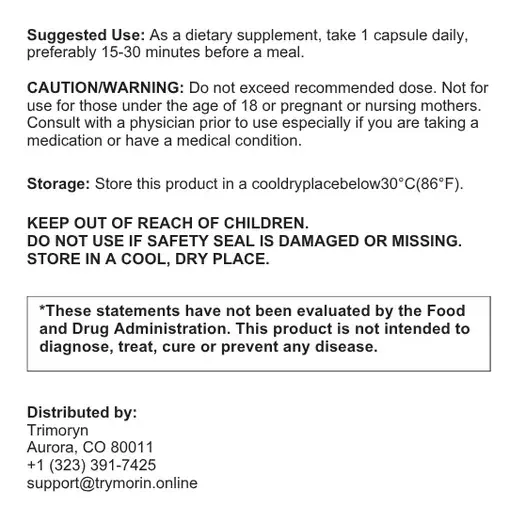
Yes, you can take Trimoryn daily: the label says one capsule a day, preferably 15-30 minutes before a meal, and not to exceed that dose. Swallow it with a full glass of water. The before-meal window mainly gives the fiber line a head start, and riboflavin absorbs fine either way, so taking it with food is a minor deviation, not a mistake. If you miss a whole day, skip it and do not double up.
Why a supplement label bothers with timing at all
Somewhere between the bottle and the first capsule, most people skim past one line: "take 1 capsule daily, preferably 15-30 minutes before a meal." That is the exact suggested-use wording printed on the Trimoryn label. It is easy to read as a formality, the kind of instruction nobody actually follows to the minute. It is also not arbitrary.
This piece looks at why supplement timing gets specified at all, what a pre-meal window is usually built to achieve, where fat-soluble and water-soluble ingredients differ, why fiber in particular cares about timing, and what realistically happens if you take a dose late, with food, or not at the stated time at all. It also says plainly where the label and some published review pages disagree on this exact point.
What "15-30 minutes before a meal" is usually trying to achieve
A 15-to-30-minute window before eating is trying to do one main thing: get a dose into your system and partly processed before food, and the digestive changes food triggers, arrive behind it.
Eating changes gut pH, slows stomach emptying, and dilutes anything already in there. For an ingredient that works best absorbed on something close to an empty stomach, a head start of fifteen to thirty minutes lets it move along before a meal changes the conditions around it.
It is also, practically, an anchor. "Before a meal" ties a supplement to something you already do every day, which is most of why timing instructions specify meals rather than clock times in the first place.
Fat-soluble versus water-soluble absorption
| Type | How it travels | Typical timing advice | Example on this label |
|---|---|---|---|
| Fat-soluble | Absorbed alongside dietary fat, into the bloodstream via the lymphatic system | Usually taken with a meal that contains some fat | None of this label's ingredients are fat-soluble vitamins |
| Water-soluble | Dissolves directly, absorbed largely independent of a meal's fat content | Can typically be taken before, with or after food without losing much absorption | Riboflavin (vitamin B2), 25 mg |
| Plant extracts and fiber | Absorption and effect vary by compound; some fibers specifically benefit from arriving ahead of food | Depends on the specific ingredient; often before a meal for fiber | Konjac extract fiber, mangosteen, prickly pear, cinnamon, and the rest of the panel |
This distinction is why a multivitamin heavy in A, D, E and K often comes with "take with food" advice: those vitamins need dietary fat around to absorb well. Riboflavin, the one ingredient on this panel with an established Daily Value, is water-soluble, so it does not depend on a meal being present to be absorbed. The other ten ingredients on the panel are plant extracts, a mineral-adjacent fiber and two live cultures, none of which are fat-soluble vitamins, so the fat-absorption argument for taking this specific product with food does not really apply here.
That leaves the fiber line as the ingredient most likely to actually benefit from a specific timing window, which is the next section. For the full panel and every printed amount, see the Supplement Facts page.
Why fiber specifically goes before a meal
Konjac extract fiber, standardized to 90% glucomannan, is the one ingredient on this panel where "before a meal" is not just a habit-forming suggestion, it is close to the standard advice for how fiber like this is meant to be used.
Glucomannan is a soluble fiber that absorbs water and swells substantially in volume. The EU-authorized health claim for glucomannan and weight is built around taking it before meals, with water, specifically so the fiber has a chance to begin swelling and create a sense of fullness ahead of eating, rather than arriving after a meal is already underway (EFSA et al., 2010).
Glucomannan carries a documented choking and blockage risk if swallowed without enough liquid. A regulatory advisory recommends taking any glucomannan-containing product with at least a full glass of water, and avoiding taking it right before lying down (Health et al., 2010). This label's amount, about 45 mg of glucomannan inside a 50 mg extract, is far below the multi-gram doses tied to the case reports behind that advisory, but the same water habit is sensible with any product containing this fiber.
The other 392 mg of weighed ingredients on this panel, the plant extracts and vitamin, do not carry the same before-meal mechanism. For them, "before a meal" mostly matters as a consistency habit rather than an absorption requirement.
What happens if you take it with food instead
Taking this capsule with food instead of fifteen to thirty minutes ahead of it is not a dosing error, and nothing on the label describes it as dangerous. The realistic effect is smaller and less dramatic than the phrasing "before a meal" might suggest.
- Riboflavin absorbs regardless of food timing, being water-soluble; taking it with a meal will not meaningfully change how much reaches you
- The plant extracts on this panel have no published requirement to be taken fasted; most human trials of these ingredients dosed them at mealtimes without reporting a timing-driven difference
- The fiber line loses some of its intended pre-meal fullness effect if it swallows down with or after food, since it arrives without the head start the EFSA-based advice assumes
- Nothing about taking it with food changes the safety picture; the full-glass-of-water rule for the fiber line still applies either way
In short: with food is not the label's instruction, and it is a real deviation from it, but it is a minor one rather than a mistake with consequences. The part worth protecting is the water, not the exact minute relative to a meal.
What happens if you forget entirely
Missing the window entirely, forgetting the capsule until well after a meal, or skipping a day outright, is a more common scenario than taking it at the wrong time relative to food, and it deserves its own honest answer.
| Situation | What to do |
|---|---|
| You remember an hour or two after eating | Take it then, with a full glass of water. A late dose is better than a skipped one for a once-daily product like this. |
| You remember right before bed | The label's caution is general, but taking the fiber-containing capsule immediately before lying down is worth avoiding; if it's very late, it is reasonable to wait for the next day rather than take it lying down. |
| You forget an entire day | Skip that day's dose and resume the normal schedule the next day. The label says not to exceed the recommended dose, which rules out doubling up to make up for a missed day. |
| You are not sure if you took it | Skip that dose. For a capsule at this dose level, taking an accidental second one is a much smaller concern than a doubled dose of something more potent would be, but there is no reason to guess. |
None of this is a substitute for reading your own label or asking a pharmacist about a specific product. The general pattern, though, holds for most once-daily supplements: consistency across weeks matters far more than precision within any single day.
Why some review pages say "with a meal" anyway
Here is the detail worth stating plainly rather than smoothing over: some published third-party review pages describe taking Trimoryn with a meal, while the label itself says before one. That is a genuine discrepancy, not a rounding difference in wording.
The printed label is the instruction that governs this product. Third-party review pages are written by people who did not manufacture the bottle, and a mismatch between what a review says and what the label says should always be resolved in the label's favor. If you are following directions from a review page rather than the bottle in your hand, check the bottle. That is true for Trimoryn and it is true generally: the container in front of you outranks any summary of it.
It is easy to see how the mismatch happens. "With a meal" and "before a meal" describe similar daily habits, and a reviewer working from memory or from a different product's convention can blur the two without noticing. It does not change the practical stakes much, given the previous section, but it is exactly the kind of small inconsistency worth naming rather than quietly repeating.
Building the habit so timing stops being a decision
Pick one meal, every day
Breakfast is the easiest anchor for most schedules, since it is the most consistently timed meal for most people. Any meal works as long as it repeats daily.
Set the capsule where you'll see it before that meal
Next to a coffee mug, a toothbrush, or car keys works better than a cabinet you only open when you remember to.
Pour the water first
Since the fiber line needs a full glass, getting the water ready before the capsule removes the excuse to take it dry.
Give the routine a few weeks before judging it
A single well-timed dose changes very little on its own. The habit of taking it daily, at roughly the same point in your day, is what actually accumulates.
Treat a missed or late dose as normal, not a reason to quit
One missed day does not undo weeks of consistency. Resume the next day at the usual time rather than trying to compensate.
Timing habits are worth building, and they are not a substitute for anything a clinician has prescribed. If you take medicine on a schedule, keep that schedule exactly as directed regardless of when you fit Trimoryn in around it, and ask your pharmacist if you are unsure whether the two should be spaced apart.
For the rest of the suggested-use text, including storage and the caution line, see how to use it. For what the fiber line is doing at its printed amount, see fiber supplements and water.
Questions readers ask
Why does the label say to take it before a meal instead of with one?
The main reason is the fiber line: glucomannan is meant to start absorbing water and swelling before food arrives, which is the basis for the EU health claim built around taking glucomannan before meals.
Does it matter if I take it with food by accident?
Not much. Riboflavin absorbs regardless of food timing, and the plant extracts have no documented before-meal requirement. The fiber line loses some of its intended pre-meal effect, but nothing about taking it with food is unsafe.
What if I forget to take it until hours after eating?
Take it then, with a full glass of water. A late dose on the same day is preferable to skipping it entirely for a once-daily product like this one.
What if I miss an entire day?
Skip that day's dose and resume the normal schedule the next day. The label says not to exceed the recommended dose, so doubling up to make up for a missed day is not advised.
Why do some review pages say to take it with a meal?
That appears to be an inconsistency on those pages rather than an alternate official instruction. The printed label says before a meal, and the label is the instruction that governs, not a third-party summary of it.
Does the water matter more than the exact timing?
For the fiber line, yes. Glucomannan carries a documented choking and blockage risk without enough liquid, so a full glass of water with every dose matters regardless of whether it lands before, with or after a meal.
Are any of these ingredients fat-soluble, needing food to absorb?
No. None of the ingredients on this panel are fat-soluble vitamins. Riboflavin is water-soluble, and the rest are plant extracts, a fiber and two live cultures, none of which depend on dietary fat to be absorbed.
How do I build a consistent timing habit?
Anchor it to one specific daily meal, keep the capsule somewhere visible near that routine, and pour the water before taking it. Consistency across weeks matters more than hitting the exact 15-to-30-minute window every single day.
Keep reading
Akkermansia, the newest gut strain
What Akkermansia muciniphila is, the small 2019 pilot trial behind it, EFSA's clearance, and the gap between that trial ...
Read →1,470% Daily Value, explained
Riboflavin at 25 mg reads as 1,470% DV on Trimoryn's panel. What that means, why there is no upper limit, the yellow uri...
Read →How much does Trimoryn cost?
Pack sizes, days of supply and how to pick the right one.
Read →Order Trimoryn from the authorized retailer
60 servings per bottle, 1 to 2 droppers a day. Kits of 2, 3 or 6 bottles run from $49 a bottle on the sales page, with a 60-day money-back guarantee. Questions first? Call +1 (323) 391-7425.